

ClusterPOS empowers its support team with an AI agent on Amazon Bedrock
 Amazon Bedrock
 Amazon ECS (Fargate)
 Amazon RDS for PostgreSQL
 AWS Secrets Manager
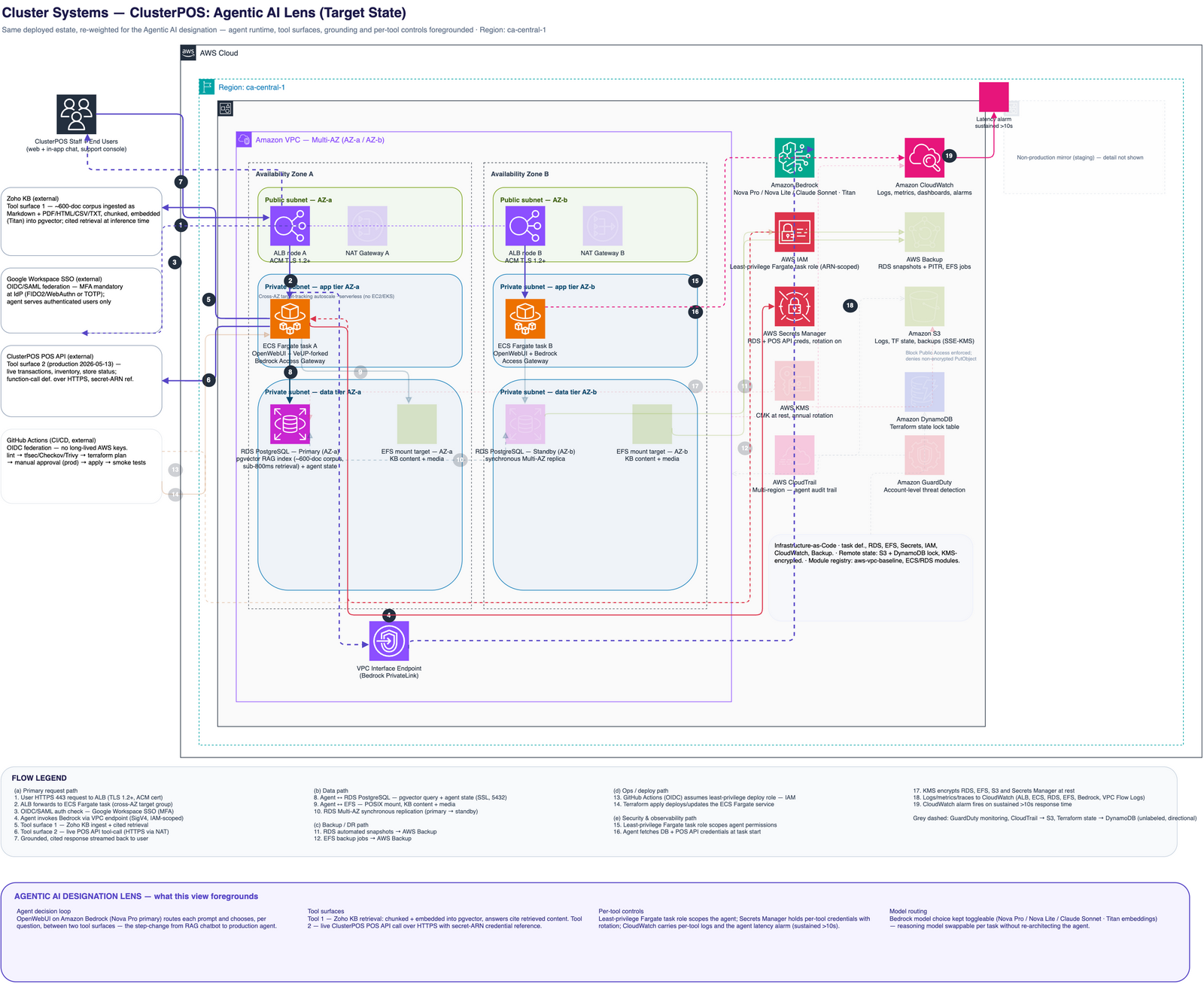
What VeUP operates for Cluster Systems in production is an agent, not a single-shot chatbot: OpenWebUI routes each user prompt on Amazon Bedrock Nova Pro, decides when to call which tool — a Zoho knowledge-base retrieval tool for static product knowledge, or a live POS API tool for operational data — grounds its answers in retrieved content with citations, and can toggle between Bedrock models per task.
The challenge
Cluster Systems’ retail point-of-sale SaaS supports restaurant and retail operators whose questions split into two very different classes: “how does this feature work?” — answerable from documentation — and “what is happening in my store right now?” — answerable only from live operational data. A retrieval-only chatbot handles the first class and fails the second. Serving both from one assistant meant building a system that could decide, per question, which data source to consult, call it safely with the right credentials, and ground its answer in what came back — the defining problems of a production tool-using agent.
The solution
VeUP deployed OpenWebUI as the agent framework on Amazon ECS Fargate, fronted by an Application Load Balancer with AWS Certificate Manager TLS, and wired it to Amazon Bedrock with Amazon Nova Pro as the primary reasoning model — model choice kept toggleable so alternates can be routed per task. The agent’s tool surface has two members: a Zoho knowledge-base retrieval tool over the curated product corpus, and a live POS API tool that fetches operational data on demand — the addition that took the system from RAG chatbot to tool-using agent when it shipped to production. Responses are grounded in retrieved content and cite their sources. Amazon RDS for PostgreSQL and Amazon EFS carry state, AWS Secrets Manager holds the tool credentials, and the estate is instrumented with Amazon CloudWatch and protected by AWS Backup and KMS encryption — agent infrastructure run with the same operational rigor as the POS platform it serves.
Production outcomes
| KPI | Result |
|---|---|
| Agent capability | Multi-source tool-use live in production: the agent selects between static knowledge-base retrieval and live POS data fetch per question, grounding answers with citations; the POS tool surface shipped to production as a working extension of the original build. |
| Responsiveness | End-to-end latency held to the acceptance targets of p50 ≤ 5s and p95 ≤ 10s at nominal load, with zero critical CloudWatch alarms at acceptance. |
| Operational posture | Verified backup-restore into staging; Fargate task sizing measured post-launch and right-sized down — agent compute tuned on evidence, not estimates. |
| Lessons & continuation | The step-change from chatbot to agent is the second tool: once the model chooses between data sources, grounding, credential scoping, and per-tool observability become the engineering surface; keeping model routing toggleable on Bedrock preserves leverage as the model landscape moves. |
 Application Load Balancer
 AWS Certificate Manager
 Amazon EFS
 AWS Backup
 AWS KMS
 Amazon CloudWatch