

ClusterPOS empowers its support team with an AI agent on Amazon Bedrock
 Amazon Bedrock
 Nova Pro
 AWS Fargate
 RDS + pgvector
 CloudWatch
Production OpenWebUI Retrieval-Augmented Generation chatbot on Amazon Bedrock for a European SaaS retail point-of-sale platform.
The customer
ClusterPOS is a European SaaS retail point-of-sale platform serving small-to-medium retail businesses. Their support workflow ran through a Zoho-hosted knowledge base — a static documentation tree with no conversational, grounded assistance — which meant linear support-headcount growth as the customer base expanded.
The challenge
ClusterPOS needed to deflect repeat support questions, accelerate time-to-resolution, and stay competitive against retail-POS rivals increasingly shipping AI-assisted in-product help. The team had no prior Generative AI capability in production and needed an AWS partner to take them from zero to a production chatbot within a sub-three-week build window.
The solution
VeUP designed and delivered a production OpenWebUI chatbot grounded on the customer's Zoho knowledge base, with Amazon Bedrock as the inference plane and Amazon Nova Pro as the production primary foundation model. The Bedrock integration was built model-toggleable from the start, so ClusterPOS can bring new models into production without redeploying. Live POS data is reached through OpenWebUI tool/function-calling, letting end-users ask grounded questions over both static documentation and live operational data.
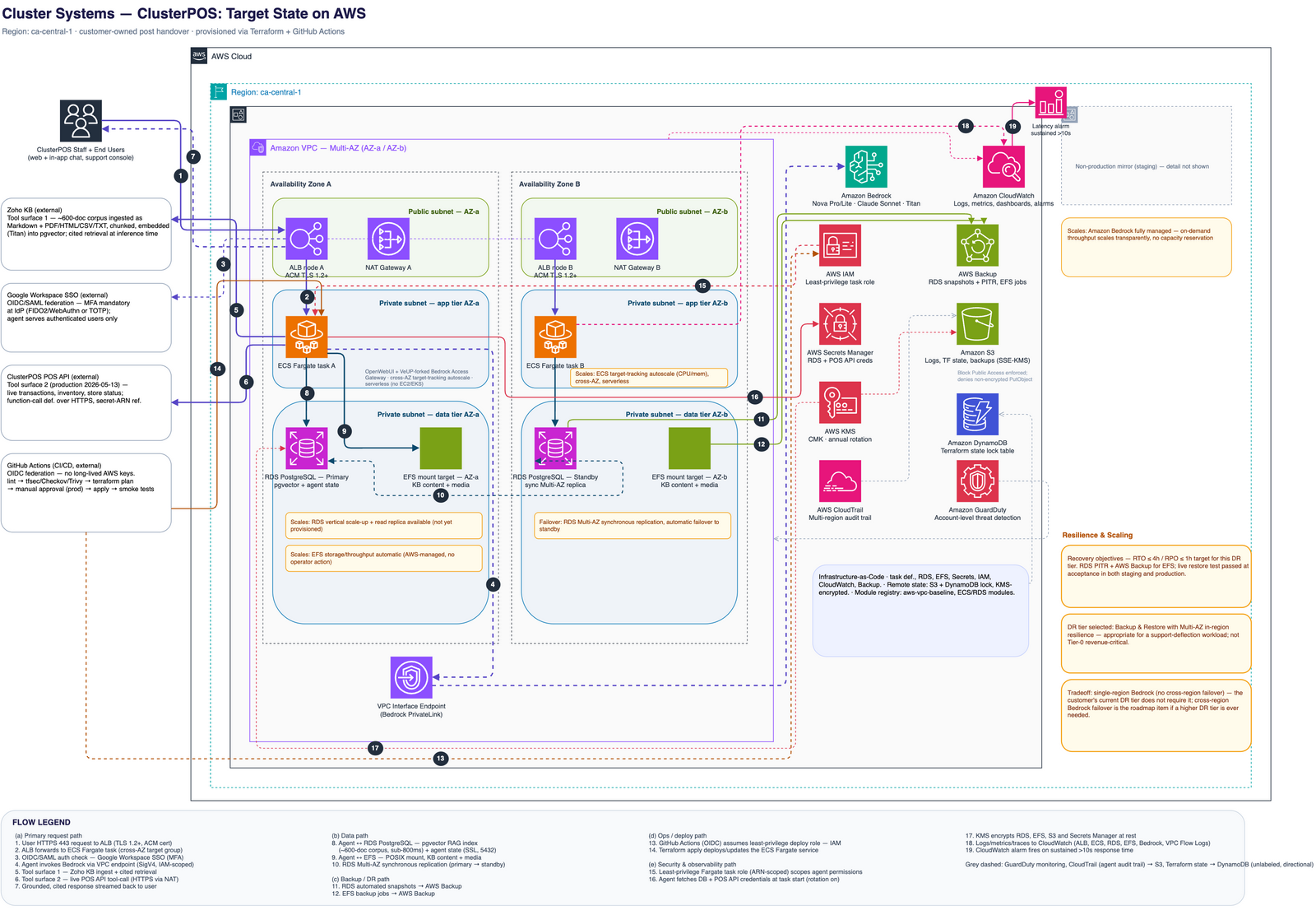
The production deployment runs in the customer's AWS Canada (Central) region (ca-central-1) across a Multi-AZ VPC, with Application Load Balancer + ACM TLS at ingress, ECS Fargate hosting the OpenWebUI and VeUP-forked Bedrock Access Gateway, and Amazon RDS for PostgreSQL with pgvector for application state plus the RAG index. The chatbot cut over to production in November 2025; a POS integration extension followed in May 2026.
Architecture
The ClusterPOS support agent, end to end — from the original static-KB support workflow through to the production Multi-AZ VPC on Bedrock Nova Pro, with the RAG and live-POS tool surfaces, security, and observability planes.
Where it started
Assessed baseline · new implementationSoftware & Internet — retail point-of-sale SaaS · Europe · AWS infrastructure in ca-central-1A Zoho-hosted documentation tree — no conversational assistance for staff or end users; support agents self-served by browsing docs.
Staff queried the live ClusterPOS system directly for transaction, inventory, and store-status questions — no tool-using agent surface over live data.
Ruled out third-party SaaS chatbot vendors outright, and drove a custom build on AWS instead of an off-the-shelf support bot.
Linear support-headcount growth with no deflection lever in place to bend the curve.
No prior GenAI or agent workload existed — the agent framework, RAG, tool use, and IAM scoping all had to be sourced externally.
A new implementation — there was no prior chatbot or agent architecture to migrate. This is the starting context as assessed at engagement start.
Production outcomes
| KPI | Result |
|---|---|
| RAG retrieval latency | Sub-800 ms across a 600-document staging corpus, with end-to-end answers in one to two seconds — well inside the committed service levels (p50 ≤ 5s, p95 ≤ 10s). |
| Continued engagement | After handover, Cluster Systems kept coming back to VeUP — for an architecture session on replacing the NLB with an ALB and AWS WAF, and a review of IAM and AWS Config — then signed on for ongoing managed services. |
 Amazon EFS
 Application Load Balancer
 AWS Certificate Manager
 AWS Secrets Manager
 AWS IAM
 AWS KMS
 AWS Cost Explorer