
VeUP designs a computer-vision inventory platform on AWS for an F&B ML startup
 Amazon Kinesis Video Streams
 Amazon Rekognition
 Amazon SageMaker
 Amazon Bedrock
Shared anonymously — the customer’s name is held by VeUP and available on request.
An Omani ML startup wanted to point cameras at warehouse shelves and let the platform do the counting. VeUP designed the whole pipeline — Kinesis Video Streams through Lambda and Rekognition Custom Labels into DynamoDB, SageMaker quality models, a full analytics tier — and priced a two-client proof of concept so the founders knew exactly what the first step would cost before committing a dollar.
The challenge
The startup helps F&B companies predict product distribution down to the individual customer by connecting and processing their data sources. Its next act was bigger: computer-vision inventory management — automated counting, quality assessment, predictive analytics, automated reordering. To get there from a small enterprise base, it needed a credible AWS reference architecture and a realistically costed entry point, not a leap of faith.
The solution
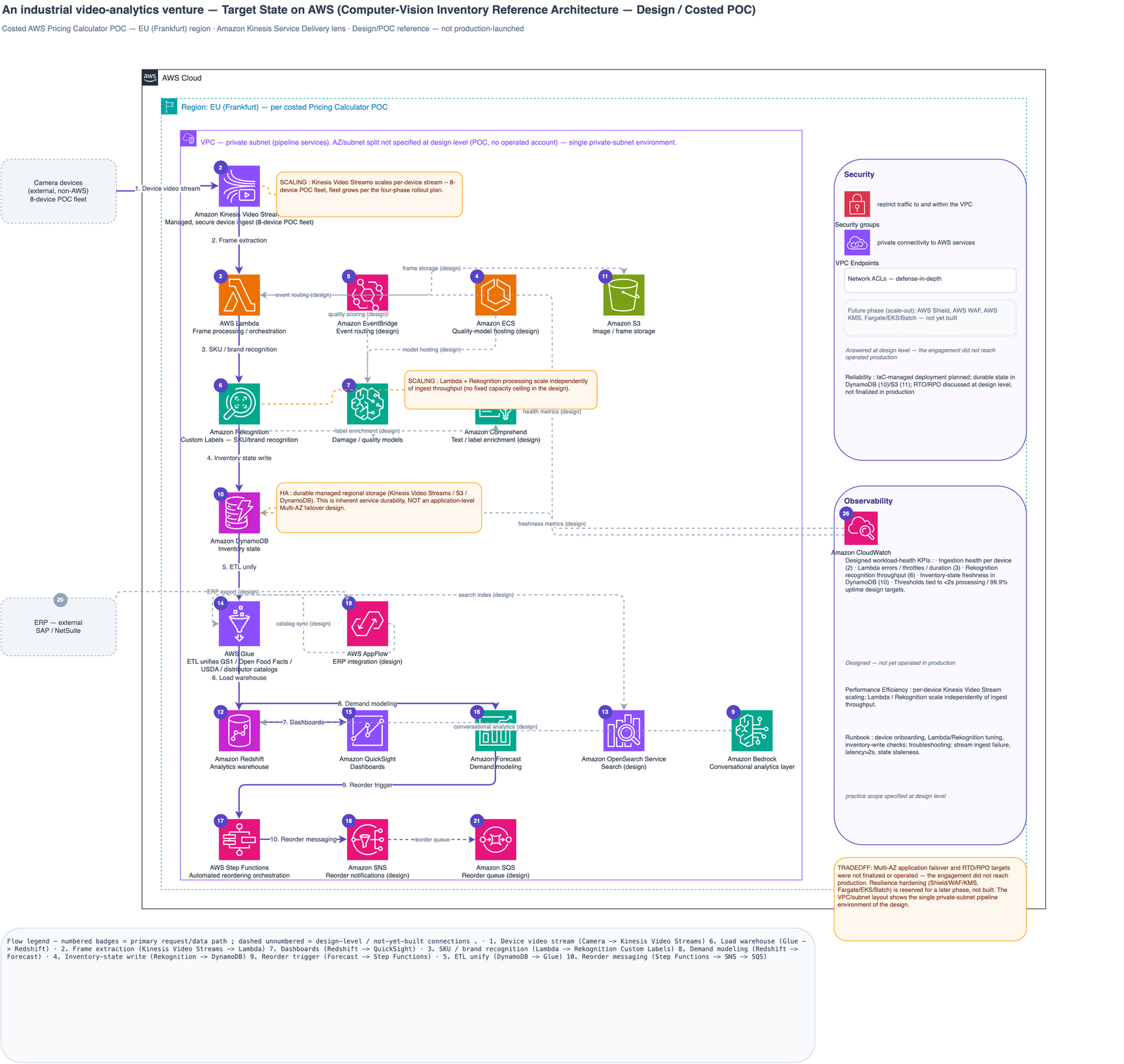
VeUP authored a full computer-vision solution design and a costed AWS Pricing Calculator POC. The designed pipeline ingests camera feeds through Amazon Kinesis Video Streams to AWS Lambda to Amazon Rekognition Custom Labels (SKU/brand recognition) to Amazon DynamoDB inventory state; Amazon SageMaker runs damage/quality models; AWS Glue unifies product databases (GS1, Open Food Facts, USDA, distributor catalogs) into Amazon Redshift with Amazon QuickSight dashboards and Amazon Forecast demand modeling; AWS Step Functions orchestrate automated reordering; and an Amazon Bedrock layer provides conversational analytics over the data so users ask questions instead of reading charts.
Design outcomes
| KPI | Result |
|---|---|
| Design outcomes | A phased reference architecture — four phases over roughly 10-12 months, entered through a two-client proof of concept — with the POC fully costed before any build. The design sets its own bar: detection accuracy above 95%, processing under two seconds, 99.9% uptime. Those are targets for the build ahead, not measured results — this is a scoped design, and the page says so plainly. |
| Timeline | The costed proof of concept landed in February 2025; the full design followed in May 2025. Building it is the startup’s next move. |
| Cost posture | The two-client POC prices out at ~$25,066/month (projected, AWS Pricing Calculator, Frankfurt) — Kinesis Video Streams for 8 devices, Rekognition Image at 500K images/month, S3, Lambda, and DynamoDB on-demand. A pre-build estimate, so the founders knew the number before writing a line of code. |
| Lessons & continuation | Kinesis Video Streams is the natural ingest entry point for a real-time CV inventory pipeline; Rekognition Custom Labels handles SKU/brand recognition without bespoke model training; a Bedrock conversational layer over the analytics tier is what turns dashboards into self-serve answers. |
Architecture
A costed design reference — the build is still ahead.
Where it started
Assessed baseline · design/POC engagementFood & Beverage — computer-vision / ML SaaS · Oman · no launched production workloadIn-store and warehouse feeds checked manually, camera by camera — no automated detection of SKU, brand, or damage.
GS1, Open Food Facts, USDA, and distributor catalogs sat unintegrated — recognition output had no canonical product record to resolve to.
SAP / NetSuite order, inventory, and distribution data had no automated path into any inventory pipeline.
Restock decisions relied on manual stock review; demand and quality insight lived in ad hoc spreadsheets — reactive, not predictive.
A design/POC engagement with no launched production workload — the baseline above is the operating picture as assessed, and the architecture shows the design that closes each gap.
 AWS Lambda
 Amazon DynamoDB
 AWS Glue
 Amazon Redshift
 Amazon QuickSight
 Amazon Forecast
 AWS Step Functions