
CGHero rebuilds its CDN on Amazon CloudFront, cutting third-party search cost
 Amazon CloudFront
 Amazon Lightsail
 AWS WAF
 Route 53
Shared anonymously — the customer’s name is held by VeUP and available on request.
VeUP rebuilt the customer's content-delivery plane on Amazon CloudFront, moving its public site off Strapi on AWS Amplify to WordPress on Amazon Lightsail — DNS/SSL cutover with rollback, WordPress-tuned edge caching, AWS WAF hardening, improved Core Web Vitals, and reduced third-party (Algolia) cost.
The challenge
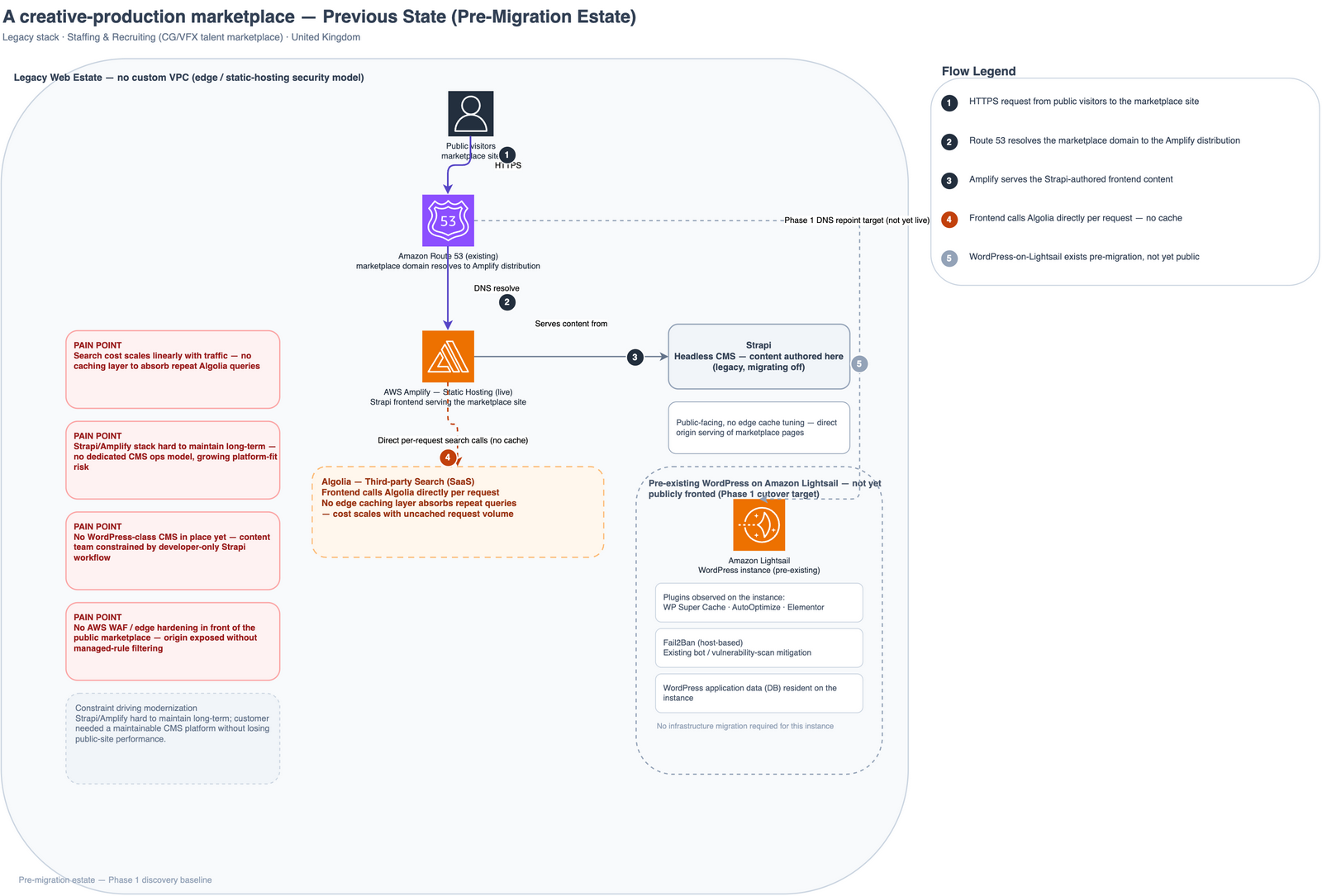
The customer, a CG/VFX talent marketplace, ran its public site on a Strapi frontend on AWS Amplify. It needed to modernize onto a maintainable WordPress platform without losing public-site performance, while getting third-party (Algolia) search cost under control and hardening the edge. And the move had to happen as a controlled cutover with a safe way back.
The solution
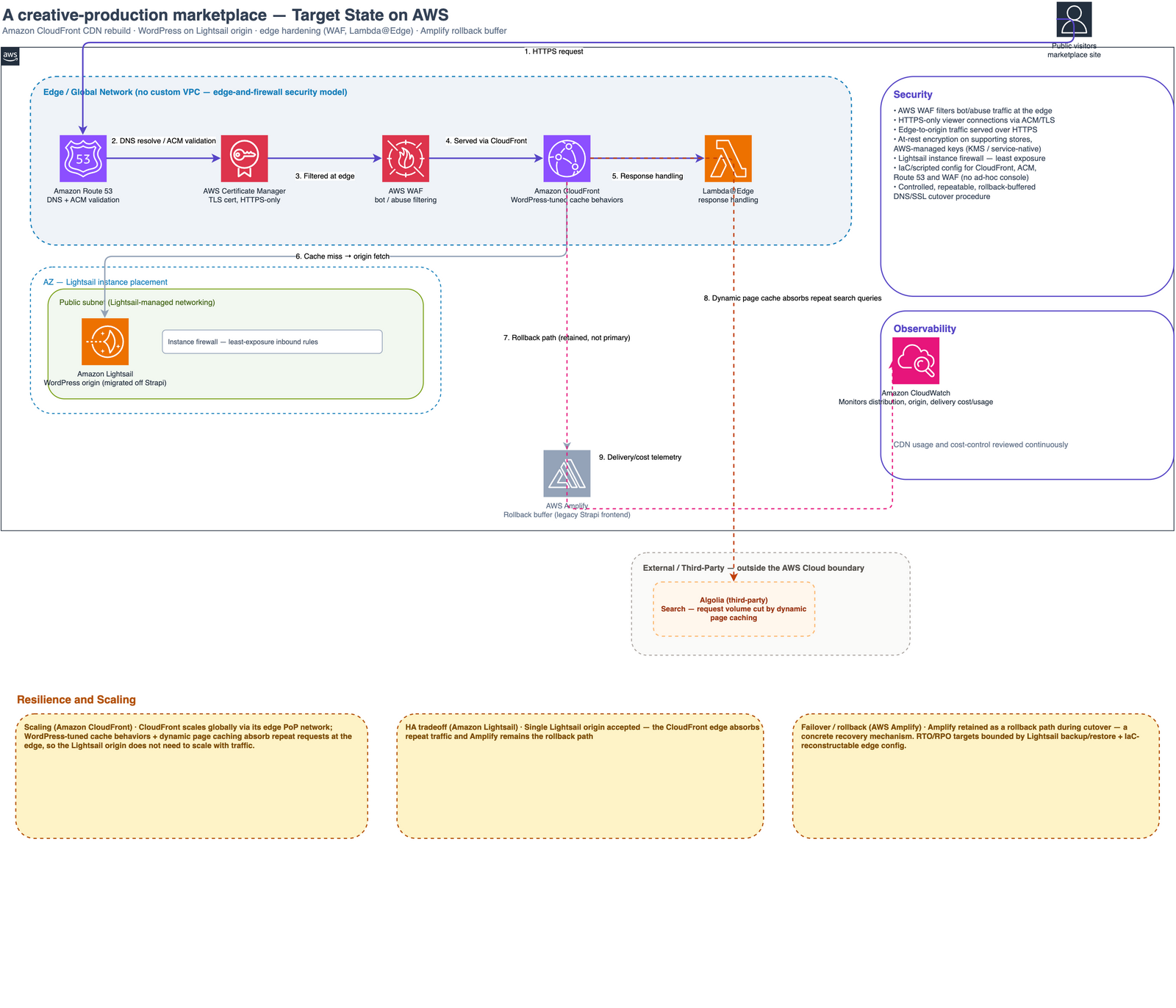
A two-phase Amazon CloudFront CDN rebuild and modernization. Phase 1 cut the frontend over to a new/updated Amazon CloudFront distribution with a WordPress origin on Amazon Lightsail and WordPress-appropriate cache behaviors, provisioned AWS Certificate Manager SSL with Amazon Route 53 DNS validation, and executed a controlled Route 53 DNS/SSL cutover retaining AWS Amplify as a rollback buffer. Phase 2 hardened the edge — dynamic page caching to mitigate Algolia cost, a caching-architecture review, Lambda@Edge response handling, Core Web Vitals performance optimization, AWS WAF security hardening against bots/abuse, and CDN usage/cost control — monitored with Amazon CloudWatch.
Architecture
From a Strapi-on-Amplify stack to a WordPress-on-Lightsail origin behind a rebuilt Amazon CloudFront edge.
Production outcomes
| KPI | Result |
|---|---|
| Production outcomes | The marketplace's public site now runs in production through the rebuilt Amazon CloudFront distribution over a WordPress-on-Lightsail origin, with AWS WAF protection and HTTPS-only delivery. Core Web Vitals improved on the rebuilt edge with WordPress-tuned caching, and dynamic page caching cut third-party (Algolia) search request volume and cost. |
| Engagement window | The relationship began in October 2024. Migration delivery ran through 2024–2025, the CloudFront rebuild and Phase 2 hardening landed in 2025, and the work continues. |
| Cost / TCO posture | Dynamic page caching at the CloudFront edge cut third-party (Algolia) request volume and cost, while Lightsail capacity right-sizing and CDN usage controls kept infrastructure spend in line. |
| Lessons & continuation | A CloudFront rebuild with an Amplify rollback buffer makes a CMS migration cutover low-risk; absorbing repeat requests at the edge (dynamic page caching) is a direct lever on third-party search cost; WAF managed rules belong in front of a public marketplace from the cutover. |
 AWS Certificate Manager
 Amazon CloudWatch
 Lambda@Edge