
Allstacks hardens its DevOps SaaS with a 47-finding six-pillar WAR
 AWS Well-Architected
 Amazon Aurora
 AWS KMS (CMK)
 Bedrock AgentCore
VeUP ran a full six-pillar AWS Well-Architected Review of Allstacks's production engineering-intelligence SaaS — 57 best-practice questions — surfacing 47 prioritized risk items (31 High, 16 Medium), each mapped to a pillar with a concrete remediation, plus a top-5 remediation roadmap.
The challenge
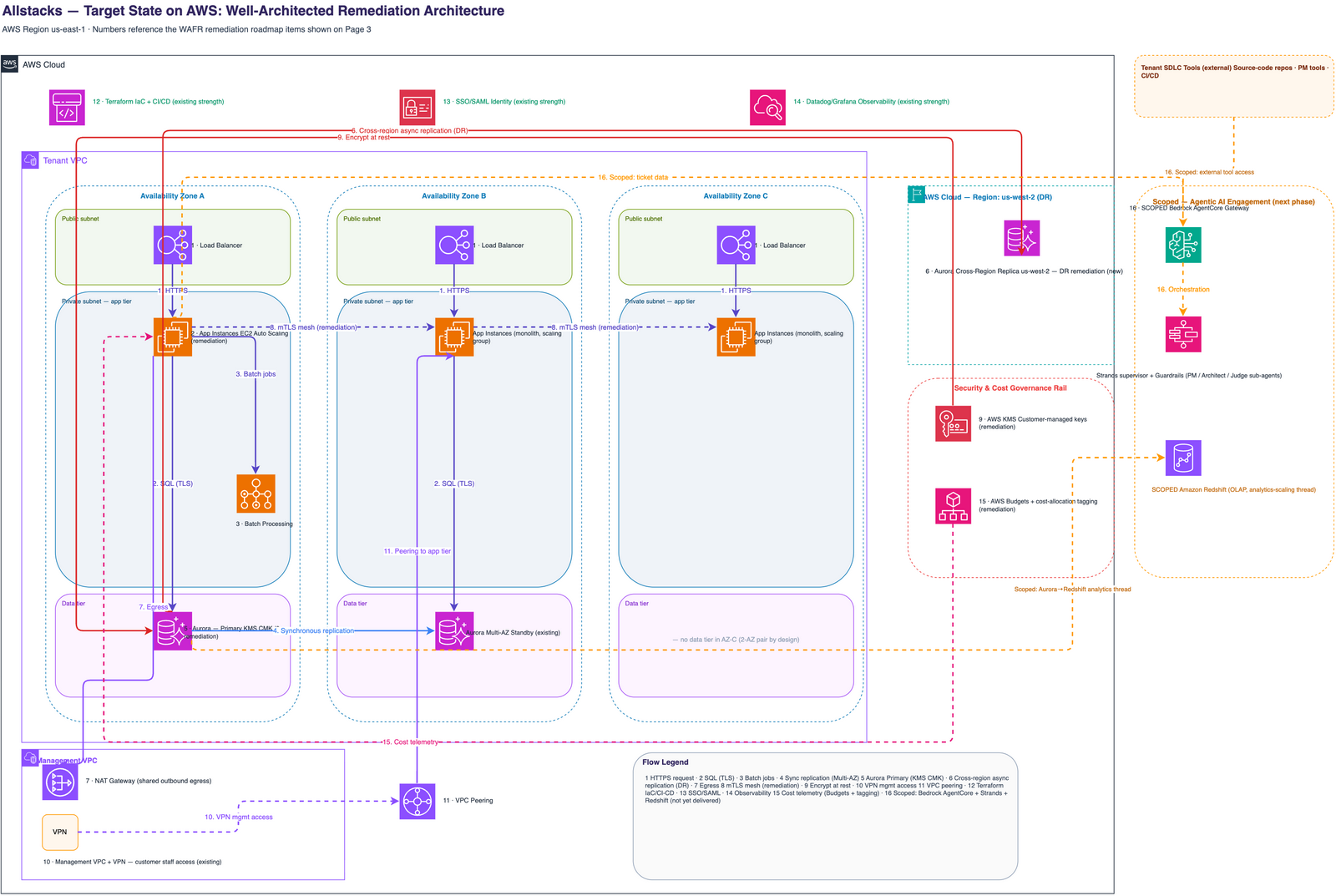
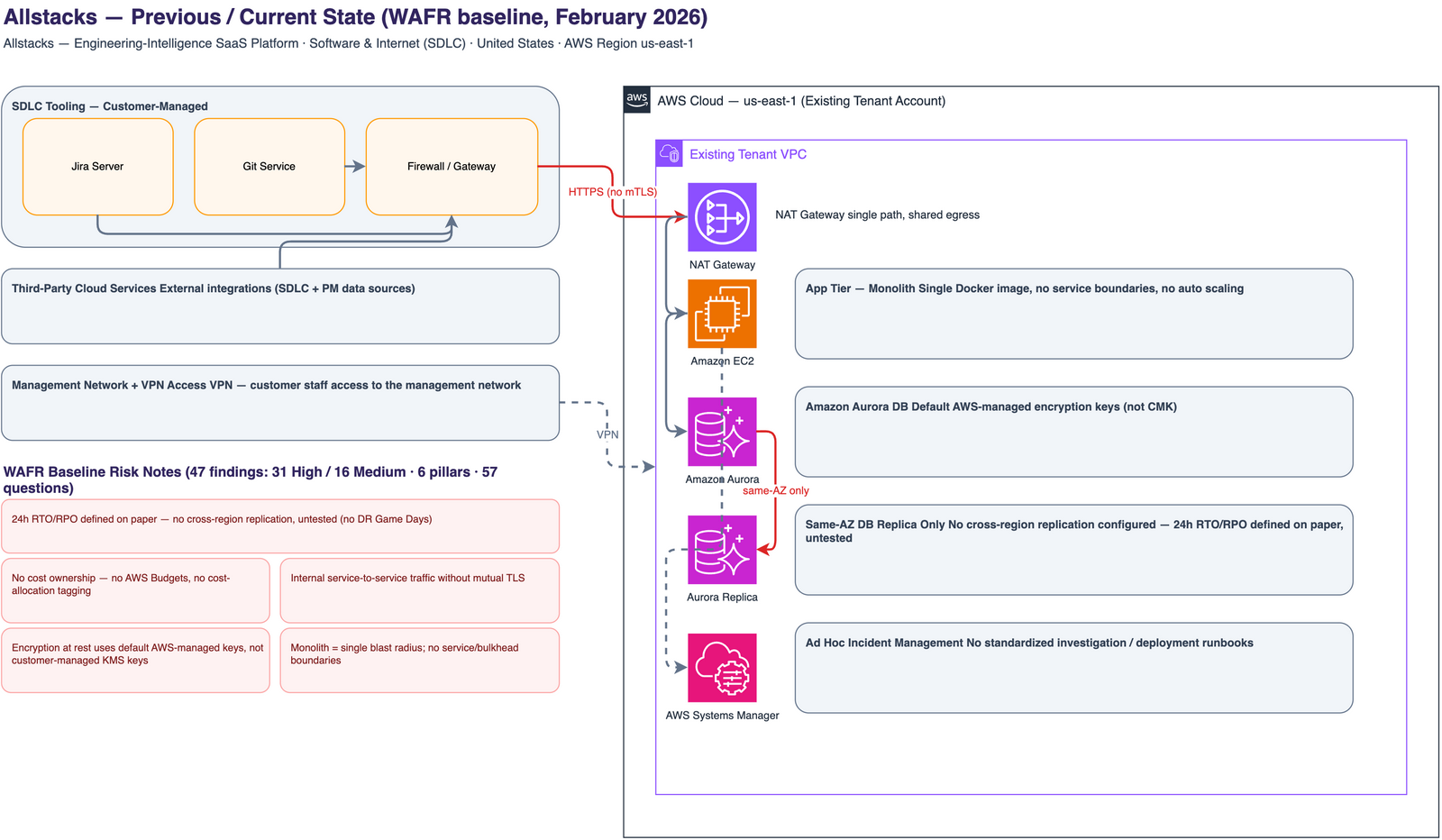
Allstacks runs a production engineering-intelligence SaaS on AWS (us-east-1) that had grown organically alongside the business. The team had strong foundations in deployment automation and identity but had never had the architecture independently measured against AWS best practice. As it scaled toward larger enterprise customers, Allstacks needed an objective, prioritized read on where the workload carried real risk — particularly resilience, security, and cost governance — before that risk surfaced as downtime or unbounded spend. Specific concerns: a monolithic application (single codebase, single Docker image) with no service boundaries; a 24-hour RTO/RPO defined on paper but no cross-region replication and no DR testing; no formal cloud financial management; internal service-to-service traffic without mutual TLS; data encrypted at rest with default AWS-managed keys; and ad-hoc incident management.
The solution
VeUP conducted a structured AWS Well-Architected Framework Review across all six pillars — Operational Excellence, Security, Reliability, Performance Efficiency, Cost Optimization, and Sustainability — covering 57 best-practice questions, combining stakeholder interviews with evidence-based scoring to produce a per-pillar risk profile, prioritized findings, and a concrete remediation per item. Top remediation approaches: decompose the monolith toward service/bulkhead boundaries, automate cross-region replication for critical databases, and establish a DR-test/Game Day cadence to validate the 24h RTO/RPO; establish cost ownership, AWS Budgets, cost-allocation tagging, and move the web tier onto EC2 Auto Scaling; introduce mutual TLS (or AWS App Mesh) for internal auth and upgrade encryption at rest to AWS KMS customer-managed keys; standardize investigation/deployment runbooks; and document and recovery-test the Amazon Aurora backups. VeUP built on existing strengths — Terraform IaC + CI/CD, SSO/SAML, Datadog/Grafana — so the roadmap extended investment rather than replacing it. Separately, VeUP scoped a three-phase agentic ticket-evaluation engagement on Amazon Bedrock AgentCore (Bedrock governance layer with per-tenant metering, Guardrails, and an LLM-as-a-Judge loop; an AgentCore Gateway; and a Strands supervisor orchestrating PM-Evaluator, Architect-Evaluator, and LLM-Judge sub-agents) — the scoped next phase of the engagement.
Production outcomes
| KPI | Result |
|---|---|
| Production outcomes | All six AWS Well-Architected pillars assessed across 57 best-practice questions, surfacing 47 prioritized risk items (31 High, 16 Medium) — each mapped to its pillar and paired with a concrete fix. Allstacks now sees exactly where its risk lives (Reliability 10 High/2 Medium, Security 7/4, Cost Optimization 7/0, Operational Excellence 6/3, Performance Efficiency 1/2, Sustainability 0/5), with a top-5 roadmap ranked by business impact. The three-phase agentic Bedrock AgentCore engagement is scoped and was validated with Allstacks in April 2026; its build — and its results — are still ahead. |
| Engagement window | A partnership since 2024. The full Well-Architected review landed in February 2026; remediation and the scoped three-phase agentic engagement carry the work forward. |
| Cost / TCO posture | Cost Optimization was one of six pillars assessed (7 High-Risk items); the remediation establishes cost ownership, AWS Budgets, cost-allocation tagging, and EC2 Auto Scaling to align supply with demand. The savings themselves sit on the roadmap — recommendations today, results as remediation lands. |
| Lessons & continuation | A monolith's blast radius is itself a Reliability finding — decoupling toward service boundaries is the high-leverage remediation; an RTO/RPO defined on paper without DR testing is unproven until Game Days validate it; upgrading from default to KMS customer-managed keys and adding mutual TLS are concrete, enterprise-readiness security moves a scaling SaaS should make before, not after, the enterprise deal. |
 AWS Budgets
 Amazon EC2 Auto Scaling
 AWS App Mesh
Architecture
The six-pillar Well-Architected Review took stock of the existing AWS us-east-1 environment and paired each finding with a concrete remediation — from monolith decomposition and cross-region DR to AWS KMS customer-managed keys, mutual TLS via AWS App Mesh, and AWS Budgets cost governance.
What the review surfaced, pillar by pillar.
- 6 high-risk / 3 medium findings
- 7 high-risk / 4 medium findings
- 10 high-risk / 2 medium — the deepest pillar
- 1 high-risk / 2 medium findings
- 7 high-risk findings
- 5 medium findings, none high-risk